Mev's Tips for Directing Drama with Children

Begin with Prayer
Directing a production can be an overwhelming job! I usually have at least one nightmare while I am in the midst of preparing for a production. I’ll dream that we are performing the play and one child is on stage in jeans and a T-shirt because she forgot her costume or everyone is forgetting their lines or some such worry. Once I dreamed that during a isasterous performance, my mom went on stage and told the audience to repeat after her, “This is a good play! We are going to stay to the end!” Directing children’s theatre is a lot of pressure, but it’s a lot of fun, too. Here are some tips from what I have learned.
Begin each rehearsal with a prayer. Pray before each performance. Pray a lot of times in between. If you are having an especially difficult rehearsal and things aren’t going satisfactorily and you are losing your patience, stop the practice, get everyone’s attention, and pray. Each year at the beginning of our first performance, I have all the cast members kneel in a circle on the stage as we dedicate the theatre, the production, and the cast and crew members to the Father and remind everyone that it is all for His glory.
Gaffer's Tape - A Director's Best Friend
If you’re like me, you will think, “Oh, I can just tell them where to stand on stage and they’ll remember.” Beware! I have learned the hard way that it usually doesn’t work like that. You’ll end up with little people in the back and big people in the front and seventy percent of the cast on one side of the stage with thirty percent on the other side when they are supposed to be evenly distributed! Mark spots on the stage with gaffer’s tape so that everyone knows where to stand in a particular scene. Sometimes one piece of tape can be assigned to different cast members for different scenes. I usually have a “spot” for each cast member for the scenes when all or most cast members are on stage at the same time. When I say, “Go to your spot” everyone knows exactly what I mean. You’ll want to try to get across to your cast members that they should walk casually to their spots so that it doesn’t actually look like they are walking to a piece of tape on stage!
Rehearsals
The first two years I directed a production I held practices once a week for several weeks and then more often as the performance date drew near. Since then, I have found that a more intense, focused time for rehearsals has worked better. For the last several years I have held about eight practices over a two-week period, each lasting about three. We then have a dress rehearsal and are ready to perform. This isn’t many practices, but they are close together and it is easier for the children to remember your directions from one day to the next.
I have a no electronics policy for cast members during rehearsals and performances.


Costumes
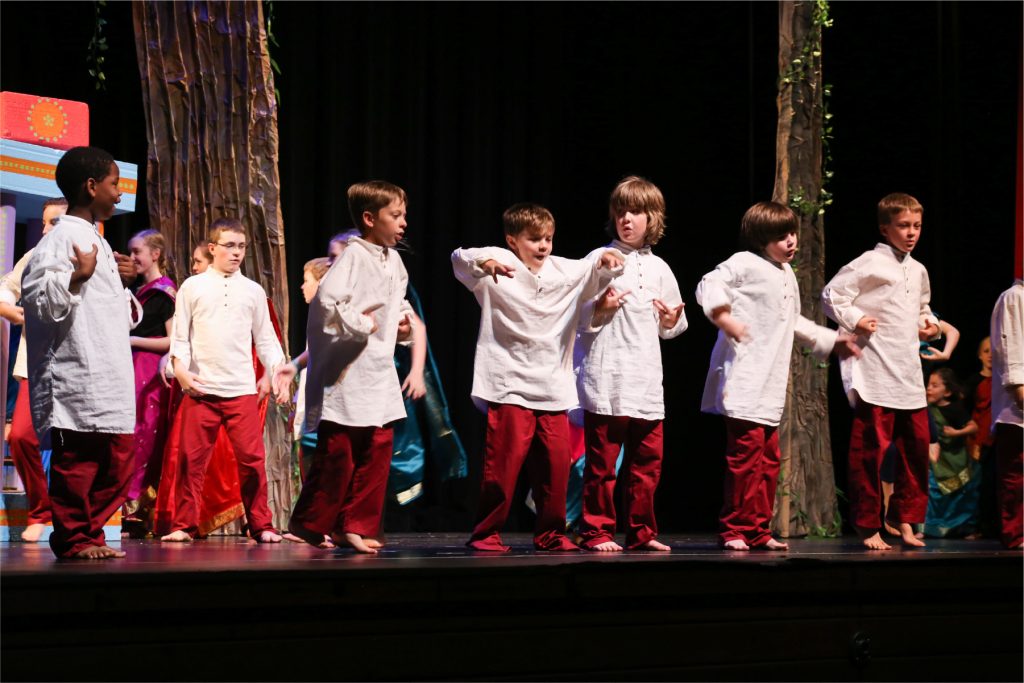
For most of my productions I have given the parents guidelines for how their children’s costumes need to look and have let them go from there. All costumes then have to be approved by me. I have my cast members wear their costumes to the first rehearsal to get a visual of how everyone looks together. This gives people a little time if anything needs to be altered or replaced.
Things to Tell Your Cast Members
Study At Home
When I direct a play, I distribute the scripts to my cast members a few weeks before rehearsals begin. I tell the cast members to learn their lines and cues before we start practicing together. They are also supposed to practice the songs before rehearsals begin. Each household should access to recordings of the songs. When cast members study at home, rehearsals go much more smoothly. You don’t have to take time to help people with their lines and prompt them when it is their turn to speak if they have already learned this at home. Cast members can more easily to get into character and learn what to do with their hands if they aren’t holding a script while on stage. Ban scripts from the stage after the first rehearsal!
Don’t Be Yourself, Be Your Character
Sure, you might not say things the way they are written in the script and you might not do what your character is directed to do, but when you are on stage, you are not yourself. Forget yourself and become your character. Your character would not be embarrassed of saying and doing the things in the script, so you shouldn’t be, either!
Face the Audience
Keep backside time to a minimum. When you are talking to another cast member on stage, you are not really talking to him. You’re talking to the person in the audience who is sitting on the back row. Make sure that person can see your face and see your mouth moving and see the action.
Loudly, Slowly, and Clearly
When I tell my cast members, “Say your lines how?” They all know the answer: “Loudly, slowly, and clearly!” It has become a running theme from year to year for us to laugh and say that together during rehearsals. I say it over and over because it is important. If the audience can’t hear the lines, the cast members have wasted a lot of time to learn them. If they can’t be heard, they are letting their fellow cast members down. If the audience can hear noises, but can’t distinguish one word from another, the experience of watching the play is likely to be grueling and frustrating instead of pleasant and encouraging. Make sure your cast members say their lines how? Loudly, slowly, and clearly!
Smile!
Unless the character is supposed to be sad, smile! The audience would much rather look at a stage full of children who are supposed to be happy and are smiling than a stage full of children who are supposed to be happy and look miserable. You can have someone sit on the front row and have a “SMILE” sign to hold up when needed, even during a performance. If your cast is anything like mine are, you will have to tell them over and over and over to “Smile!”
The Show Must Go On!
I’m sure volumes could be written about the mishaps and mistakes that have taken place on stage over the centuries! Here are a few from the Homeschool Dramatic Society’s history. No matter what happens, the show must go on!
When the snobby English girl in I Am Dreaming of America angrily whipped off her cape before her first solo, she accidentally grabbed her pearl necklace as well. The necklace broke and a shower of pearls fell to the stage and began to roll around. The necklace was a special family heirloom that belonged to the actress’ grandmother, but she didn’t miss a beat. She went right on with her song as if nothing had happened. The show must go on!
During our first performance of Sign of Love, most of the children were standing in a circle ready to perform a singing game. One of the younger boys suddenly had a seizure and fell to the stage. The lead actor went over to him and helped him off the stage, and the show went on. Everyone kept his cool and to some in the audience, the incident looked like it was a part of the play with the lead actor helping a little boy who was sick or hurt. The show must go on! (Thankfully, the seizure was an isolated incident for the boy and he turned out to be fine.)
During a performance of I Am Dreaming of America, we reached the scene where several of the younger girls jump rope together. We had established who would jump where during the scene, but some of the jump ropes were missing during the performance. Those who had ropes began to jump to the music that was being played and in the middle of the song, unprompted, one little girl who who had a rope stopped jumping to give one of the girls who didn’t have a rope a turn. I was so proud of her! She could have stayed in the spotlight and jumped through the whole song, but she gave someone else a chance. The show must go on!
During a performance of Journey of Faith, one girl was supposed to enter and say a line. She didn’t come on, and no one knew why. We waited through an awkward silence, and finally she appeared. She had answered someone else’s cell phone that was ringing behind the stage and had thus missed her cue. The show must go on, but the cell phones must go off!
During a performance of Sign of Love, something triggered the theatre smoke alarm system, and the massive fire curtain automatically came down on the stage. We had to evacuate the building–cast members and audience members alike. The fire department came and gave us the okay to reenter the building. Everyone took their places–but the fire curtain malfunctioned and the theatre staff couldn’t get it to go back up! We ended up doing the rest of the play in the tiny space available between the fire curtain and the edge of the stage. It was a very memorable experience! The situation unexpectedly became a way to shine the light of Jesus to everyone in the theatre. After the incident, we the person in charge at the theatre sent an email that said, “I wanted to take a moment to once again thank you for your patience and understanding as we worked to solve the issue with the fire curtain on Saturday. You all handled the situation very well and watching your cast’s positive attitude and ability to adapt the show to perform in front of the fire curtain was inspirational. I think the audience was amazed as well!” The show must go on!
During a performance of He Is Near, one cast member was supposed to throw himself down on the stage in a violent fit as a reaction to snake bite. The cast member got into his role so much that when he threw himself down, he broke his collarbone! He soldiered on through the performance, unable to move that arm, and went to the ER after the curtain call. He went through the final performance with his arm in a fabric sling because, you know, the show must go on!